
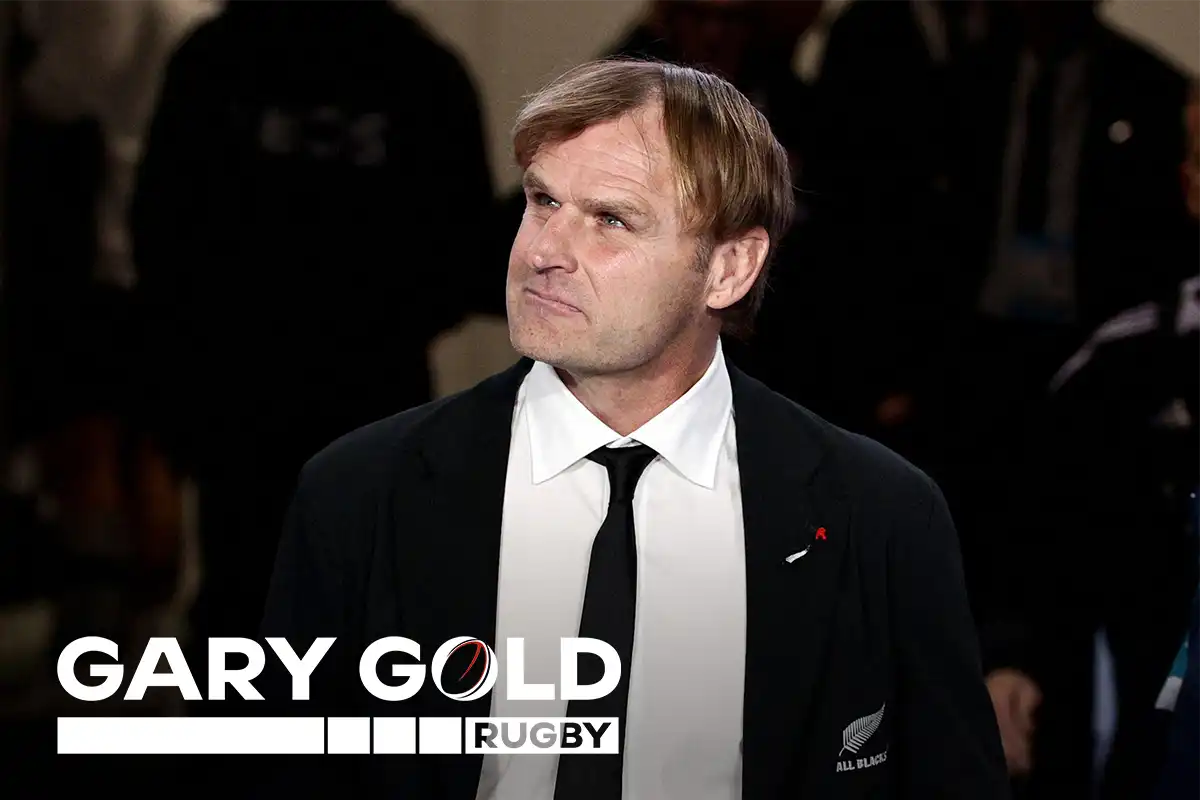
The rugby world woke up last week to a headline that still doesn’t feel real: Scott “Razor” Robertson is out as All Blacks head coach following New Zealand Rugby’s end-of-season review.
It’s sudden. It’s disruptive. And yes – it sends that familiar chill through every professional coach alive. But my reaction isn’t fear. It’s frustration – and it’s aimed at something far bigger than one man.
This isn’t about job security – it’s about the direction of the sport
Let me be clear: I’m not outraged because “if Razor can be fired, any coach can.”
We already know that. Many of us have lived it. And I’m not writing this because I know Razor personally – although I do – and I respect his obsession for the craft and what that role meant to him.
The real issue is what this decision represents: rugby is importing the hire-and-fire mentality that has destroyed sustained excellence in other sports.
What the review messaging really signalled
New Zealand Rugby framed this as a mid-cycle decision – the right time to reassess trajectory toward 2027.
And whether people want to admit it or not, what came through from the messaging was not a ruthless technical review based on a defined performance framework. It felt like something else. It felt like internal sentiment mattered, and that player feedback played a meaningful role in the outcome. Now, player feedback matters. It should matter.
But if player sentiment becomes a decisive lever – especially during difficult periods – then we are walking straight into a high-performance trap: the tail starts wagging the dog.
Because elite environments are not built on comfort. They’re built on standards. And standards, by definition, make people uncomfortable when they’re slipping.
The 2007 All Blacks lesson New Zealand once understood better than anyone
This is the part that makes me feel like its a philosophical U-turn. In 2007, the All Blacks went out in a World Cup quarterfinal. It was a national shock. Everybody expected the coaches to be fired.
They weren’t.
New Zealand kept Graham Henry, with Steve Hansen and Wayne Smith, and they backed the programme through the hard times. And what followed wasn’t instantly pretty. There were difficult seasons. Real turbulence. Real lessons. But those lessons were the foundation of what came next – New Zealand winning the World Cup in 2011 and again in 2015.
That isn’t luck. That’s continuity doing what continuity does: it compounds learning instead of resetting it.
Hard times don’t automatically mean a coach is failing. Often, they’re exactly where the coach learns how to win.
The Springboks prove the point better than anyone
And this is where I believe the lesson becomes even clearer. For many years, South Africa were the poor cousin to the All Blacks.
That doesn’t mean we lacked passion. South Africa has always played with pride, with intensity, with emotion. We’ve produced extraordinary players for decades. But for a long time we didn’t produce consistent dominance.
Just look at the numbers: how many Rugby Championship and Tri-Nations titles have South Africa won compared to New Zealand? Not many.
And one major reason is uncomfortable but true: we chopped and changed coaches repeatedly.
Turbulent times triggered panic. Panic triggered change. And change triggered the reset button again and again. No continuity. No long-term learning. No stable high-performance model.
What has changed under Rassie Erasmus is not just that the Springboks have won trophies. It’s that there has been continuity of thinking.
Yes, Rassie won a World Cup relatively quickly after coming in – and he’s been backed strongly since. But the real evidence of continuity is deeper than a trophy cabinet.
South Africa can now field depth that would have been unthinkable years ago. The Springboks have developed a playing group that is broader, more experienced, and more battle-hardened than almost any other nation.
And that didn’t happen by accident.
It happened because the coaching group has had time to plan, evaluate, rotate, test young players, and build an environment where experience is spread across the squad – not trapped inside 15 starters. You don’t build three teams worth of Test-quality players overnight.
That only happens when a programme is given room to breathe long enough for development to mature.
The England football mirror (respectfully, but honestly)
This is sensitive – but the comparison matters. England’s national sport is football. The stadiums are packed. The league is a global monster. The passion is unmatched.
So how have they not won a World Cup since 1966? I don’t buy simplistic answers like “too many foreigners.” Brazil and Argentina don’t rely on domestic cohesion either – their best players are scattered across Europe.
The deeper issue is cultural and structural: instability.
A system that too often treats turbulence as failure, and keeps restarting instead of building. When England found more continuity under Gareth Southgate, their consistency improved.
The point isn’t to insult English football – it’s to show what happens when an ecosystem becomes addicted to resets.
And today, rugby is drifting that way.
This is the real danger: coaches being measured by the wrong scoreboard
This is where professional sport is in grave danger. If rugby continues measuring coaching performance only by:
- wins and losses
- trophies in the cabinet
- public sentiment
- and media noise
…then we are heading into a future where 90% of teams will be deemed “failures” every season and will respond by replacing the coach.
That is not high performance. That is gambling. And it’s not just bad for performance – it’s bad business. In football, you now see clubs paying off multiple managers simultaneously. At one stage, Manchester United were paying settlement packages for more than one previous coach while hiring the next one.
That isn’t sustainable. And it certainly isn’t intelligent.
Final word: this decision widens the gap
This is why I believe last week’s announcement wasn’t just a coaching decision. It was a philosophical one. New Zealand once had the courage to hold steady when the public demanded chaos. That courage was part of what made them the All Blacks. Last week felt like the opposite.
And the uncomfortable consequence is this: South African supporters will quietly be jumping for joy.
Because while other nations reset and restart, South Africa continues to compound. The gap widens. Not because one nation has better players – but because one nation is being allowed to keep learning without rebooting its system every time pressure arrives.
If rugby wants dynasties, it has to stop behaving like chaos is a strategy.
“You can replace a coach quickly – but you can’t replace cohesion quickly. And you don’t build dynasties by rebooting the system mid-cycle.”
Gary Gold