

Three teams. Twelve points each. One Saturday afternoon. This is the most open title race in years — and the data might help explain why.
A 90-point classic at Murrayfield. A historic first in Rome. And Ireland grinding their way to a third straight win under the Dublin lights. Round 4 of the Six Nations didn’t just deliver rugby — it delivered chaos, heartbreak, and the kind of results that rip a title race wide open. Three matches. Three seismic shifts. And suddenly, three teams are locked on twelve points heading into the most compelling Super Saturday in Championship history.
In my last piece, I tracked the repeatable behaviours that tend to separate winning teams from losing ones — carrying with quality, defending honestly, kicking with intent — and used match-coded data to show where every team stood heading into the sharp end of the tournament. The thesis was straightforward: win contact, win matches. Round 4 didn’t just confirm that thesis. It blew the tournament apart.
Over 40,000 game-related actions have been coded and analysed across all twelve matches this tournament. What those numbers show you is fascinating — not because they’re big, but because they reveal things you’d never pick up just by watching on TV. They show you why teams win, not just that they win. And as someone who’s been in and around coaching rooms, what I find most interesting is how the data gives you a glimpse into what the coaching groups behind these teams are actually doing week to week — the adjustments, the decisions, the quiet fixes that never make the highlights reel but so often decide the outcome.
One thing I’d love to share with anyone reading this — especially those who love the game but might not have been inside a coaching environment — is just how relentless this job is. People see the eighty minutes on TV. They don’t see the hundred hours behind each one. The review sessions, the individual conversations, the sleepless nights after a loss when you’re replaying decisions and wondering what you could have done differently. Coaching at this level requires you to purposefully divorce yourself from the emotion of the occasion, because your focus has to be laser sharp. Getting swept up in the highs and lows — good or bad — is something every coach battles with, and there’s no textbook for managing it. Only time in the middle. Only experience. And sometimes, even experience isn’t enough.
So when I talk about what teams are doing well or where they might improve, I say it with genuine respect for the people doing the job. I’ve been in those rooms. I know how hard it is. This isn’t a know-it-all’s column. It’s one coach’s perspective on a tournament that has been absolutely magnificent.

Six Nations standings after Round 4. Three teams level on 12 points — separated only by points difference.
Look at that table. Three teams locked on twelve points heading into the last weekend. France top on points difference — their attack has been ferocious, scoring 163 points in four matches. But Scotland’s momentum and Ireland’s physicality are right there. This is going to be decided on a single Saturday afternoon. Before we get there, let’s unpack how Round 4 set all of this up.
Scotland 50–40 France: The Performance of the Tournament
Before we talk about the result, let me share a number that, for me at least, tells you everything about this game. Across all twelve matches in this tournament, I tracked which team led in carry metres — essentially, which team made more ground with ball in hand. The team that carried further won ten out of twelve times. Now, that doesn’t mean carrying further causes you to win — rugby is never that simple. But it’s a strong indicator that when a team is dominant in contact and making ground, the rest tends to follow. Territory, momentum, scoreboard pressure — it all flows from that.
Scotland didn’t just carry well against France. They carried with fury. Seven tries. Fifty points. Darcy Graham and Kyle Steyn both scored doubles. Pierre Schoeman, Ben White, and Tom Jordan all crossed. It was relentless, heads-up, tempo rugby against the team that had looked untouchable for three rounds.
But here’s what you wouldn’t have picked up from watching on TV: the cracks in France’s armour had been visible in the data for weeks.
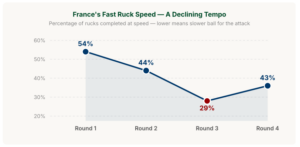
France’s Fast Ruck Speed — A Declining Tempo. Percentage of rucks completed at speed — lower means slower ball for the attack.
This chart tells you a story no camera angle ever could. France’s “fast ruck” percentage — the rate at which they recycle the ball quickly after a tackle — has been sliding all tournament. It started at 54% in Round 1, dropped to 44%, cratered to just 29% in Round 3, and only partially recovered to 43% against Scotland.
Why does this matter?
Because fast ruck ball is the engine of French attacking rugby. When it slows down, their playmakers get less time, their runners get less space, and structured defences can reset. Scotland identified this trend and went after it. They disrupted French ball at the breakdown, forced turnovers, and played the kind of broken-field rugby that punishes slow ball. It was as clinical as it was brave.
Scotland have won 25 turnovers across four rounds — more than any other team in the Championship. That’s not a fluke. That’s a team that has been coached to hunt the ball, to make life uncomfortable at the breakdown. Combine that with 28 offloads — a willingness to keep the ball alive and play what’s in front of you — and you get the kind of seventy-minute performance that puts 50 points on the best team in Europe. And there’s another dimension that often gets overlooked: Scotland’s aerial game has been the best in the tournament. They convert 71% of their contested kicks into effective outcomes, and their chase unit produces dominant contact more often than any other team. When Scotland kick, they don’t just kick — the entire system activates behind it.
Scotland’s lineout retention has gone from 74% in Round 1 to 93% by Round 4. That’s not a coincidence. That’s a coaching group identifying a weakness, fixing it systematically, and watching the results follow.
This is the detail that impresses me most. Scotland’s lineout was a mess in Rome — 74% retention contributed directly to that opening-round loss against Italy. Four weeks later, it’s at 93%. That kind of improvement doesn’t happen by accident. It happens because a coaching group sat down, identified exactly what was going wrong, drilled the solution relentlessly, and trusted the process. When your set piece is functioning at that level, you give your attacking game a platform. When your attacking game has Scotland’s offload ability and breakdown intensity, you become very, very dangerous.
Where the Coaches might focus this week
I’d suggest Scotland’s coaching group would do no harm at all by zeroing in on the two things that got them here: turnover ball and set piece.
Twenty-five turnovers and a lineout that’s gone from 74% to 93% — that’s the foundation their whole game is built on. Reinforce those habits. Remind the players exactly what made them dangerous. Don’t overcomplicate it. Don’t add. The players walking into the Aviva won’t need speeches from the playbooks of William Wallace or Winston Churchill.
They’ll know what’s at stake. The job of the coaches this week is to keep the message tight, keep the focus sharp, and trust the process that’s already working.
Italy 23–18 England: History Made in Rome
I want everyone to sit with this for a moment. Italy have beaten England in the Six Nations for the first time ever. Their first win in this fixture at the thirty-third attempt.
Thirty-three meetings. Twenty-five years of trying. And Italy had never once beaten England in this Championship. Until now.
In my previous piece, I flagged Italy’s dominant tackle count — 46 across three rounds, nearly three times England’s total. That wasn’t a novelty stat. It was a programme building its identity around physicality and confrontation.
I suggested then that England should be worried about the trip to Rome. The data was pointing that way. Italy’s 100% scrum success. Their breakdown pressure. Their willingness to put their bodies on the line every single ruck. All of it was built for an arm-wrestle, and when you go to the Stadio Olimpico with anything less than your best, you’re in trouble.
And that’s exactly what happened. Tommaso Menoncello and Leonardo Marin both crossed — Marin’s the decisive score with eight minutes left, completing a comeback from 18–10 down. The yellow cards to Sam Underhill and Maro Itoje — briefly reducing England to thirteen — gave Italy the momentum to strike. But let’s be clear: Italy didn’t win because of cards. They won because they were harder. Physically harder. Harder at the breakdown. Harder in the moments that mattered.
Here’s the data point that, for me, captures Italy’s identity perfectly: their turnovers won across the tournament read 7, then 2, 2, and 4. When they hit 7 in Round 1, they beat Scotland. When they fell to 2, they lost. When they climbed back to 4 against England, they won again. For Italy, turnover ball isn’t just a nice bonus — it’s their oxygen. When they disrupt your possession, they score. That’s who they are now, and Gonzalo Quesada deserves enormous credit for building that identity so clearly.
Two wins in a Six Nations campaign — beating Scotland and England — is genuine progress for Italian rugby. If there’s one area where the next step needs to come, it’s the aerial game. Italy kick more contestable balls than anyone in the tournament — 65 across four rounds — but convert at just 38%, the lowest effectiveness rate of any team. The intent is there, but the system around the kick isn’t matching it yet. Sharpen that, and this programme gets even more dangerous. This is a team on the rise, and with the inaugural Nations Cup starting later this year, the wider rugby world will have taken notice.
Where the Coaches might focus this week
Italy’s identity is built on turnover ball and physicality at the breakdown. It’s their competitive advantage, and I’d imagine Quesada’s message this week will be simple: be relentless in contact, hunt the ball, and back yourselves to convert the pressure. Wales’s discipline has improved dramatically, so Italy won’t get the easy penalties they might have faced in Round 1. They’ll need to earn every turnover. But that confrontational edge is what got them two wins — I’d double down on it.
Ireland 27–17 Wales: The Quiet Grind
The Friday night fixture in Dublin didn’t have the fireworks of Murrayfield or the historical weight of Rome. But it told you everything about where Ireland are right now — and here’s a chart that helps explain why.
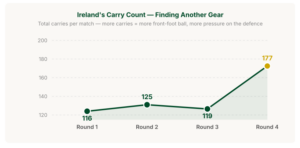
Ireland’s carry count exploded in Round 4 — the highest single-match total of the entire tournament.
Look at the shape of that line. For three rounds, Ireland were carrying at a steady clip — 116, 125, 119. Respectable. Controlled. Then Round 4: 177 carries. The highest single-match figure of the entire tournament. That’s not a team making a small adjustment. That’s a team that has fundamentally shifted gears. When Ireland carry with that volume and intent, they create front-foot ball, generate quick ruck speed, and put defences under sustained, suffocating pressure. You feel it as a defender. Every phase, another carry. Another collision. Another metre you have to give. It’s exhausting, and it’s deliberate.
And if you were in the Aviva that night, you could feel it. Ireland weren’t just carrying — they were hunting contact. Tadhg Furlong and Andrew Porter took the ball into three, four Welsh defenders at a time, legs still driving, still going forward when any normal human being would have hit the deck. Caelan Doris was everywhere — a carrying back-rower’s dream, popping up on the short side, punching through the middle, making ten, fifteen metres before anyone could bring him down. There were passages in the second half where Wales barely touched the ball for five, six phases in a row.
It wasn’t flashy. It wasn’t highlight-reel stuff. It was suffocating, attritional, deeply physical rugby — the kind that breaks defensive lines not with one big play but with the cumulative weight of twenty relentless carries. By the time Wales got the ball back, they were already a metre deeper in their own half and a breath slower to the next breakdown. That’s what 177 carries looks like from the other side. It doesn’t just beat you. It wears you out.
Jacob Stockdale scored inside six minutes. Jack Crowley, Jack Conan, and Jamie Osbourne all crossed to seal the bonus point. Wales competed — genuinely competed, and I’ll come to that — but Ireland’s physicality was simply too much. A 95% lineout success rate and a dominant tackle count that ranks second in the tournament behind Italy tells you this is a team that has its structures right and its intent locked in.
Three wins from three since that opening-night loss in Paris. And they host Scotland on Super Saturday with everything on the line.
Where the Coaches might focus this week
Ireland found their identity in Round 4: sheer carry dominance. 177 carries didn’t happen by accident — that was a deliberate decision to impose themselves physically. If I were a fly on the wall in Farrell’s coaching box this week, I’d expect the message to be beautifully simple: do it again. Carry with intent. Win the gain line. Trust your lineout. Make Scotland defend for long periods. The 177-carry game is who Ireland are at their best. Reinforce it, believe in it, and don’t let the occasion pull you away from it.
The Game Within the Game
Before I get to the coaching conversations around England and Wales, I want to talk about something that’s been sitting in the data all tournament — something that, if you only watch on TV, you’d almost certainly misunderstand. The contestable kick.
Most people see a box kick or a bomb and judge it on one thing: did the kicking team catch it? If they did, it worked. If they didn’t, it failed. Simple. Except it’s not simple at all. Because the contestable kick was never designed to be a simple 50/50 ball. It was designed to be a chess move — one that triggers a sequence of events, most of which tip in the kicking team’s favour. And when you trace what actually happens after a contestable kick lands, the picture changes completely.
Across 141 contestable kicks this tournament, the kicking team benefited 91.5% of the time. Only 12 times did the receiving team catch, retain, and genuinely build an attack. Twelve out of 141.
Let that settle for a moment. Ninety-one and a half percent. That means every time you see a box kick sail into the air, the odds are overwhelmingly stacked in favour of the team that put it there — whether they catch it or not. About 23% of the time, the kicking team wins it back outright. Another 18%, the chase pressure forces a fumble or knock-on. But here’s the bit you’d never pick up from the couch: even when the receiving team catches it cleanly — and they did, 50 times across the tournament — 68% of them kicked it straight back within five phases — median time to return kick: 19.8 seconds. They couldn’t build anything off it.
The ball was too uncomfortable, the chase was bearing down, and their shape was scrambled. So they cleared it. And now the kicking team — organised and expecting the return — had the ball deep in opposition territory with the defence in transition. That’s not a failed kick. That’s the chess sequence playing out exactly as designed.

Scotland convert 71% of their contested kicks into effective outcomes — the best in the tournament by a distance. Italy kick the most but convert at just 38%.
Scotland have been the standout, converting 71% of their contested kicks into effective outcomes — the best in the tournament by a distance. And it’s no coincidence. Their chase unit produces dominant contact 17% of the time, more than any other team. That’s a coaching group that has drilled chase lines, identified the right personnel, and built a system that turns a kick into a genuine weapon. At the other end of the scale, Italy kick more contestable balls than anyone — 65 across four rounds — but convert at just 38%. Volume without precision. The intent is there, but the system around the kick isn’t converting it.
France, interestingly, take the opposite approach. They’ve been the most selective kickers in the tournament — just 12 contested kicks in four rounds, by far the fewest — but they convert at 58% and, critically, lead the tournament in tap-back events. They’re not playing for the catch. They’re playing for what comes after the catch. It’s subtle, it’s deliberate, and it’s the kind of tactical sophistication that makes French rugby so fascinating to study.
The contestable kick doesn’t need to be caught by your own team to work. It just needs to create enough pressure that the opposition can’t play off it. That’s where the chess game lives — and that’s where matches are being shaped.
I found beautiful examples of this throughout the tournament. In Round 1, Gibson-Park’s box kick to France was collected, but Doris arrived with a sack on the catcher. France played two phases going nowhere, Dupont chipped it back, and Dan Sheehan collected on the French 67-metre line. Ireland were now in the driving seat — not because they won the original aerial contest, but because the chess sequence played out exactly as designed. In Round 3, Garbisi’s bomb into Ireland’s backfield was caught cleanly by Osborne, but Ireland then played six phases stuck between the 35 and 44-metre lines, making no meaningful progress, before grubber-kicking it back. Italy started from their own 37. They ended with a front-foot carry in Ireland’s half. All from one contestable kick that, on paper, the opposition “won.”
If you take one thing from this section, let it be this: the next time you see a box kick and the commentary says “that’s been lost,” wait twenty seconds. Watch what happens next. Because the game within the game is not about who catches the ball. It’s about who controls the sequence that follows.
A Word on England — And the Madness of Sacking Coaches
I need to say something here, and I’m going to say it plainly. I say it not as someone who has all the answers — far from it — but as someone who’s been in coaching environments long enough to know what destroys programmes and what builds them.
England have now lost three in a row. After that 48–7 demolition of Wales on the opening weekend, they’ve been beaten by Scotland, hammered by Ireland, and now lost to Italy for the first time in Championship history. The scrutiny on Steve Borthwick has intensified. The calls from certain quarters to sack the head coach have already started.
This is a cancer in professional sport. And I don’t use that word lightly.
Twelve months ago, Steve Borthwick’s England had won twelve consecutive Test matches. Twelve. That doesn’t happen by accident. It doesn’t happen because you have a poor coaching team or a broken system. It happens because a group of coaches has built something together — a system, a culture, a set of standards — and the players have bought in. The idea that you take that coaching group and blow it up because of a rough Six Nations is beyond ridiculous. It is short-termism at its absolute worst.
Now, am I saying everything is fine? No. The numbers are the numbers. England have conceded 50 penalties across four matches — the most of any team in the tournament. Their count has been wildly inconsistent: 13, then 9, then 16, then 12. That’s not a team that has its discipline sorted. It’s a team that has structural issues in how it manages the contact area, and when you give away that many penalties against quality opposition, you hand them territory and possession, and they will punish you. Every time.
But here’s where I think it gets interesting from a coaching perspective, and it’s something I was taught early in my career that has stuck with me ever since. When a talented team finds itself in a rut — and make no mistake, England are a talented team — one of the most valuable things the head coach can do is evaluate the messaging the players are receiving. In today’s professional era, you might have a handful of coaches responsible for different aspects of the game: attack, defence, set piece, kicking, skills. All doing a good job in their specific area. But here’s the thing — those areas cross over. They always cross over. And when multiple coaches are delivering messages that, even with the best intentions, slightly contradict each other or pull players in different directions, you get confusion. You get hesitation. You get penalties.
In coaching, less is more. Being ridiculously focused on the basics — alignment, timing, role clarity — can realign a talented group remarkably quickly. Sometimes the best thing you can do as a head coach is simplify the noise.
This is why, so often in rugby, the teams that come out of difficult periods fastest are the ones that strip everything back and get obsessive about the fundamentals. Not because the players have forgotten how to play — of course they haven’t — but because the clarity of what’s expected in each moment becomes absolute. Everyone knows their job. Everyone trusts the system. The noise disappears.
And this is where I’d gently suggest — and I want to be careful here, because I have no desire to question anyone’s position or suggest that anyone should lose their job — that England might benefit from adding an experienced specialist defence coach to the group. Not to replace anyone. Not to undermine anyone. But to complement what’s already there. When you look at the current coaching setup, there’s no doubt that it’s a group of huge potential. But what they perhaps lack is a figure with the kind of deep, battle-hardened CV in defensive systems that someone like a Shaun Edwards brings — someone who has spent decades specifically fixing the kind of issues England are experiencing right now. The discipline problems, the missed tackles, the defensive alignment under pressure — these are precisely the areas where a specialist with years and years of experience in that specific domain can walk in, assess the picture quickly, and make the adjustments that tighten everything up.
Think of it like a high-performance Formula 1 car. England’s car is a good one — it won twelve races in a row not that long ago. It doesn’t need a complete overhaul. It doesn’t need a new engine. It just needs its proverbial timing chains readjusted. A small, expert recalibration from someone who has done it a hundred times before. That’s not a criticism of the mechanics already in the garage. It’s an acknowledgement that sometimes you need a very specific pair of hands for a very specific problem.
This is fixable. Discipline is a coaching issue, not a talent issue. England have the players. Nobody is questioning the depth of that squad. What they need is time, honest review, and perhaps one addition to the group who can sharpen the defensive edge. Wholesale change fifteen months before a Rugby World Cup? That is madness. You don’t sack a coach who won twelve in a row and tell the players the organisation believes in long-term thinking. Those two things cannot coexist.
Regroup. Review. Improve. And back the people you believe in.
Where the Coaches might focus this week
For England heading to Paris, I’d imagine the focus will be on discipline and message clarity above all else. Fifty penalties across four matches is the stat that needs addressing, and the simplest way to do that is to tighten the focus: what are we doing at the breakdown? What’s our body position? When do we release? Strip it back to absolute basics, make the messages between coaches completely aligned, and trust the players to execute. Le Crunch has a way of bringing the best out of England. Give them clarity, give them simplicity, and let them go and compete.
Wales: The Fight is Real
Wales have lost four from four. On paper, it looks bleak. But the trajectory tells a different story, and it’s one that the coaching staff will already know.
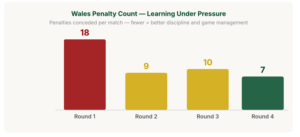
Wales conceded 18 penalties in Round 1 — a figure that contributed directly to the 48–7 mauling by England. By Round 4, they’d cut it to 7.
This is the chart I keep coming back to. Eighteen penalties in Round 1 — you simply cannot win Test rugby giving away that many. But look what happened next: 9, then 10, then 7. That’s a team that is learning. A team adjusting. A team getting better at managing the contest, even when the scoreboard hasn’t been kind. And for me, that kind of improvement says something really positive about the communication between the coaching staff and the players — the message is landing.
Against Ireland in Round 4, Wales trailed only 12–10 at half-time after Gareth Carre — a loosehead prop — shrugged off a defender and burst thirty metres for his third try in three matches. Think about that for a moment. A front-row forward, scoring for fun. And Alex Mann made 37 tackles in that game — the single highest individual count of the entire tournament. That’s not a team that has given up. That’s a team fighting for every centimetre.
One area where the fight hasn’t quite translated into results is the aerial game. Wales chase often enough — 101 chase events across four rounds — but produce dominant contact just 6% of the time. Three sacks from 101 chases. The intent is there, the effort is there, but the chase system needs sharpening. When you compare that to Scotland’s 17% dominance rate, you can see the gap between chasing hard and chasing smart. That’s a coaching fix, not a talent one.
Wales head to Cardiff on Super Saturday to face Italy. Win it — show the home crowd fight, accuracy, and purpose — and there are genuine building blocks to carry into the rest of this World Cup cycle. Competitiveness is the first step toward clarity, and clarity is the first step toward results.
Where the Coaches might focus this week
Wales’s story this tournament is the discipline improvement — from 18 penalties down to 7. That’s the evidence that the coaching messages are working. I’d expect the focus this week to be on protecting that trend: keep the penalty count low, win the contact area cleanly, and trust the home crowd to do the rest. If Wales play with the same fight they showed in Dublin — and cut the error count even further — they can absolutely win this game.
Super Saturday: The Title Permutations
Three teams on 12 points. Three matches. One afternoon. Here’s what’s at stake.
France v England — Stade de France, Paris
Le Crunch. This fixture never needs a needle. The history, the rivalry, the atmosphere in Saint-Denis — it’s one of the great occasions in world rugby. And this year, the stakes are enormous for the home side.
France must win and hope that Ireland or Scotland lose. Even after that 50-point concession at Murrayfield, France’s vastly superior points difference — +79 compared to Scotland’s +25 and Ireland’s +26 — means a bonus-point victory could be enough if results elsewhere go their way. The Parisian crowd will be electric. Galthié’s side still boast the most potent attacking arsenal in the tournament: 24 tries from 12 different scorers, with Louis Bielle-Biarrey leading the way on 5 tries for the Championship. And don’t underestimate their kicking game — France have been the most selective kickers in the tournament, contesting just 12 kicks in four rounds, but leading in tap-back events. They don’t kick for the catch. They kick for what comes after it. Against an England side leaking penalties, that tactical chess could be devastating.
England arrive having lost three in a row. The danger for Borthwick’s side is that indiscipline gives France easy territory in front of a crowd that needs no encouragement. But Le Crunch has a way of defying form. The lack of love between these two nations is well documented, and these England players haven’t suddenly forgotten how to play.
Where the French Coaches might focus this week
If I had to guess, Galthié’s priority will be getting that ruck speed back up. France are at their most lethal when they play with tempo — quick ball, width, and the ability to strike from anywhere. The data has shown a declining trend all tournament, and they’ll know it. Get back to the basics of ruck speed and clean-out efficiency, back their world-class attacking talent, and trust the Stade de France to do the rest. I doubt Galthié will need to deliver any stirring speeches this week. His players know what a title means.
Ireland v Scotland — Aviva Stadium, Dublin
This is the match that will most likely decide the Championship. Both teams need to win. The breakdown will be ferocious — Ireland’s power game, built on that 177-carry platform, against Scotland’s tournament-leading turnover count. If Scotland can maintain their 93% lineout retention and convert turnovers into scores the way they did at Murrayfield, they have a genuine shot. If Ireland can impose their carry dominance and control territory the way they did against Wales, their remarkable recovery from that opening-night defeat is complete.
For Scotland, the emotional weight cannot be overstated. Scotland last won this Championship in 1999 — the final ever Five Nations, before Italy joined to make it six. That’s twenty-seven years ago. They have never won the Six Nations. Not once since it expanded in 2000. Only Italy share that unwanted record. An entire generation of Scottish fans — people who grew up watching this team come agonisingly close, year after year — have never seen them lift this trophy. If Townsend’s men pull it off in Dublin, it will be one of the great stories in the Championship’s 143-year history. That kind of weight — the history, the expectation, the knowledge that an entire nation is watching — is either the most powerful motivator in sport, or the heaviest burden. We’ll find out on Saturday.
One thing I’m sure of: neither coaching group will be reaching for the Braveheart speeches this week. The players will bring the emotion themselves. The coaches’ job — and it’s a harder job than people realise — is to keep them grounded. Keep the focus on the process. Make sure the emotion fuels the performance rather than overwhelming it. That’s one of the great unwritten skills of coaching: knowing when your team needs firing up, and knowing when they need calming down. This Saturday, I suspect both camps will need the latter.
Wales v Italy — Principality Stadium, Cardiff
No title implications, but far from a dead rubber. Wales need a win for their confidence, for their fans, and for the credibility of the progress they’ve been making. Italy will arrive wanting to finish on a high after that historic win over England — three wins in a Six Nations would be uncharted territory for the Azzurri. Wales’s improving discipline against Italy’s turnover threat, the home crowd behind a team that has shown fight all tournament against one brimming with belief. It has all the ingredients of a cracking contest to open Super Saturday.
Final Thought
This has been the most open, most exciting Six Nations I can remember following. From France’s early dominance to Scotland’s extraordinary recovery. From Italy making history in Rome to Ireland finding another gear with its back against the wall. From Wales quietly improving to England navigating a painful but ultimately valuable period of learning.
Eighty-two tries. A 90-point thriller at Murrayfield. A first-ever Italian win over England at the thirty-third attempt. Three teams level on twelve points heading into the final day. And a Super Saturday that has a title race, a historic rivalry, and a pride match all kicking off on the same afternoon.
The data has told us all tournament that quality of contact tends to decide matches. Carry metres, missed tackles, lineout retention, turnovers won. The teams that do these things well, consistently, are the teams sitting at the top of this table. On Saturday, three of them go head to head for the right to call themselves champions. And with the inaugural Nations Cup launching later this year — twelve teams, north and south, competing in a structured league format for the first time — every southern hemisphere coaching group has been watching this Championship more closely than ever. The quality of the title race, the closeness of the competition, and the depth of tactical improvement across all six teams has been a powerful showcase for what the Northern Hemisphere will bring to that new stage. Believe me, they’ve been paying attention.
No coach, no data analyst, and no columnist can predict what will happen. That’s the beauty of this sport. But what I do know is that the coaching groups behind these six teams have given everything to get to this point. The hours, the sacrifice, the quiet work that nobody ever sees. Whatever happens on Saturday, the 2026 Six Nations has been a privilege to follow.
“I can’t wait.”
Gary Gold
Thank you to Cheridan Inglis and her team at INtouch Strategy for the great job in rebranding Gary Gold Rugby and creating this website.